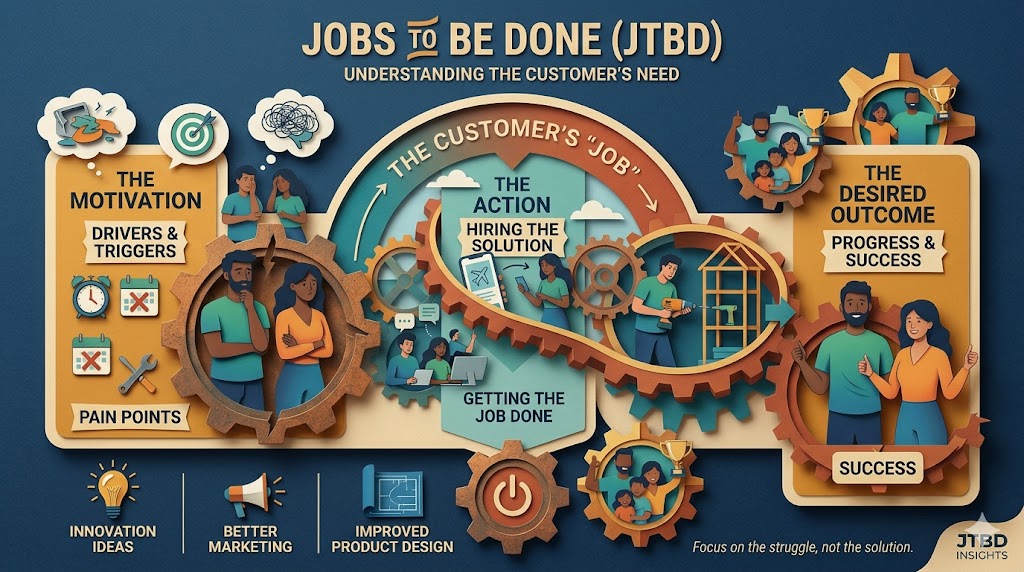

The Jobs to be Done (JTBD) methodology is one of the most widely used approaches in marketing and product management. It emerged as a result of numerous attempts by the professionals to offer a product that would be truly interesting to the market. Traditionally, the managers studied the demographic data, but this information did not explain the reason why the customers made purchases. According to the Jobs to be Done methodology, the customers do not simply make purchases; rather, they “hire” a product to perform specific tasks.
In the first Article of this series, we will discuss the methodology and how it can be used to generate the hypotheses. In the second Article, we’ll discuss why using Jobs to be Done can often be more important than introducing the innovations and additional killer features into your product.
What are the Jobs To Be Done?
The Jobs to be Done theory has been explored by many authors. For example, Anthony Ulvik, a founder of Strategyn, believes that a person “hires” a product to do a job, and the process of completing a task itself is important for a person.
- I don’t buy a drill; I buy a hole in the wall. I don’t buy a lawn mower; I buy a mowed lawn.
Clayton Christensen, Bob Moesta, Alan Clement and others, however, believe that people “hire” a product to help them to become better.
- I buy a drill not because I want to drill a hole, and not because I need a hole in the wall. I want a beautiful home.
This methodology helps us to understand why people actually “hire” the products or services. It aims to identify the core needs and goals that drive the customers when choosing a particular product.
How to use the Jobs To Be Done?
The Jobs to be Done are created based on the market research. To do this, the surveys and in-depth interviews are conducted, and the data from analytics services and other digital marketing tools is used. Once the data is received, the specialists formulate the Jobs to be Done statements based on the developed framework. You can learn more about it here, but we’ll provide a brief and simplified list of the actions.
What should a Junior Product Manager know?
- Create the statements of the Jobs To Be Done. These are the statements that precisely describe what a group of people is trying to achieve or accomplish in a given situation.
- The work to be done can be a task people are trying to complete, a goal they are striving to achieve, a problem they are trying to solve, something they are trying to avoid, or something else they are trying to accomplish.
It’s important to understand that the jobs aren’t limited by time. For example, music lovers have been hiring the products to do the job “I want to listen to good music on the go” both in the days of the cassettes and in the days of CDs. And they continue doing so now, in the time of streaming services.
And here you can find another guide on how to create the Jobs to be Done or Job Stories. It also explains how they differ from User Stories — brief descriptions of the product’s functionality written in simple, general terms from the perspective of the end user or customer.
Next, we offer you to explore some simple examples of JTBD. You can use them for inspiration when you are looking for your own ideas.
How to look at everyday life from a different perspective
First, we suggest you pay attention to the everyday products and services we use. Let’s take, for example, a food delivery app. At first glance, it seems that its main purpose is to help us to order food when we’re hungry. However, if we look deeper from a JTBD perspective, the customers “hire” such an app not just to satisfy their hunger, but to solve more complex tasks:
- “I want to save time on cooking”
- “I want to avoid the stress of cooking”
- “I want to try something new and exotic without having to go out”.
Similarly, the fitness trackers users may seem interested only in tracking the steps or heart rate, but actually, they “hire” the device to achieve a larger goal — improving health, motivating themselves to exercise regularly, or even for social interaction with the friends through online competitions and earning various achievements.
There are also cases where the same product can perform completely different functions for many customer segments. For example, the Darlean productivity system includes the modules for business process management, budgeting, document management, HR, planning, project management, training, collaboration and community. For top management, a partial list of JTBDs would include:
- I want to be able to make timely, data-driven decisions that are critical to the business
- I want to reduce the software costs by refusing unnecessary subscriptions
- I want to run my company while sitting on the beach with a cold drink
- I want to be able to work from a single interface
In turn, the back-office representatives would formulate JTBD as “I want to reduce manual labour and routine tasks”.
Thus, even the most ordinary products and services can have deep and multifaceted “jobs” that they perform for their users, going beyond their original functional purpose. Understanding these hidden tasks and striving to implement them can be the key to creating truly valuable and demanded products at the market.