
This is a cross-functional role that involves interacting with both the team and key stakeholders within the company as well as the clients.
Spoiler: there are few professions where the specialists require such a broad range of the technical and soft skills. In this case, it is important to understand that the Junior-level specialists will not be entrusted with work at all stages of product development; they will most likely be asked to focus on specific stages. Senior-level specialists, meanwhile, will get a wealth of knowledge over the course of their career, enabling them to easily launch their own product.
What does a Product Manager do?
Such a specialist identifies the user needs, oversees product development and analyses performance, making the changes where necessary. The Product Manager’s work is focused on ensuring the product success and the high level of responsibility is offset by high salary. According to Glassdoor, the Product Managers’ salaries in the US range from $121,000 to $205,000 per year. In the Kazakhstan market, the Product Managers’ salaries start from 200,000 tenge (for the specialists with virtually no experience) and can reach up to 1.4 million tenge per month for the Senior Product Managers and even more.
What career opportunities does the role of a Product Manager offer?
ProductSense study revealed that in 2022, despite the challenges with the career and development, a half of the Product Managers surveyed received a promotion in their current role; 51 per cent of them were promoted within six months to a year after being hired or their previous promotion; and 17 per cent — within three to six months.
The companies are increasing their investment in product management, whilst competition within the field remains quite high – over 70 per cent of the Product Managers invest their own time and money in continuous study.
Thus, the profession offers a rather interesting, although challenging, career path for those interested in developing the managerial skills. DAR University mentor Ardak Berdibekov emphasizes that in product-management it is fairly easy to acquire the necessary managerial skills, thereby opening the way to becoming a company executive.
Examples of the Product Manager’s work:
First, let’s define what a product is. According to the definition of Marketing Professor David Kotler, a product is “anything that can be offered to the market to attract attention, purchase, use or consumption and can satisfy a desire or need. It encompasses the physical objects, services, people, places, organizations and ideas.”
Thus, a Product Manager can work in virtually any company, for example, a soap manufacturer. The very concept of this profession originated at Procter & Gamble, where in 1931 a young marketer, Neil McElroy, first suggested that sales performance analysis should include not only an assessment of the marketing tools, but also study of the feedback from the dealers and end consumers. It was then, in the 1930s, that the first Product Managers took on coordination of all (not just marketing) processes related to the brand – from new product development to sales in the regions of presence.
Here is an example of a real job vacancy for a Junior Product Manager. PacerPro, a company that develops software for the lawyers, is looking for a specialist. The range of the responsibilities involves:
- Assisting in defining the product vision and the company’s strategic plan, including setting of the goals and key indicators
- Collaborating with UX/UI designers to create layouts, mock-ups and interactive prototypes.
- Analysing the client and industry data to identify and understand user requirements, organization goals and technical capabilities and applying these to the functional concepts.
- Creating user scenarios with acceptance criteria and developing the relevant documentation
- Coordination with the sales and engineering teams to ensure quality of functional and visual design at each stage of the software development process
Please note that even in the early stages of a career, the Product Manager’s responsibilities cover the entire product life cycle – from launch to market exit. For mid-level and senior roles, the term ‘assist’ will be removed from the job descriptions and the scope of the responsibilities will increase.
What you need to know to become a Junior Product Manager
A Product Manager ensures the product meets the user needs by regularly collecting and analysing the feedback. Depending on the stage of the product life cycle, the specialist will focus more on analysing, developing or refining the product and will interact with a wide variety of the employees.
1. Understanding the Market and Consumers
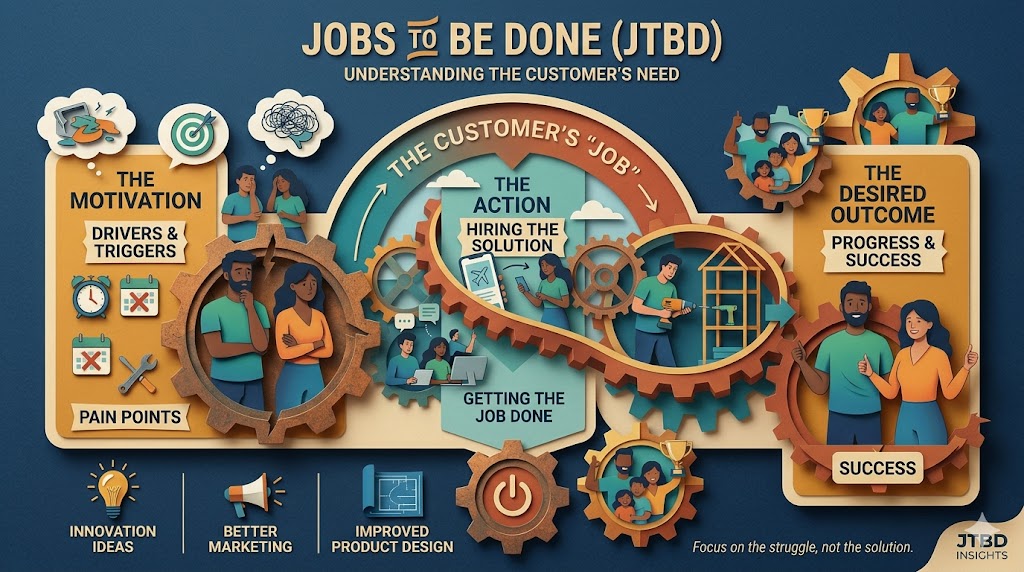
It is important for a Junior Product Manager to have a deep understanding of the market in which the product is placed and the needs of the target audience. Analysing the trends, competitors and user feedback will help to create a product that meets the clients’ expectations and requirements. His responsibilities include developing a value proposition, which requires conducting CustDev, cohort analysis, feedback analysis and UX-study. Useful tools include the JTBD (Jobs To Be Done) methodology, which helps to “uncover” people’s underlying motivation and needs, and the Voice of the Customer methodology, which provides for continuous collection of the customer feedback.
The specialist must detect and describe the product’s value to the customer – Product market fit – and achieve an acceptable Customer Acquisition Cost.
2. Formulating a Product Strategy
A Junior Product Manager must be able to develop a product strategy and identify its unique features and advantages at the market. The specialist needs the skills of business modelling, market analysis using the PAM, TAM, SAM and SOM methodologies, formulating and setting the hypotheses using the S.M.A.R.T. method, analysing profitability using the Unit-economics method. The skills in conducting A/B-testing will help in making the decisions at this and other stages.
The product roadmap includes the product vision, updates backlog and release dates for new product features. To work effectively with the backlog, it is necessary to have the prioritization skills to help to decide which product features the team should develop first. The RICE (Return, Impact, Confidence, Ease) or MoSCoW (Must-Have, Should-Have, Could-Have, Won’t-Have) methodologies, along with user persona creation skills, will help with this – it will be easier for the team to understand for whom the product is being created.
The role of a Product Manager is often confused with other roles. This is a perfectly understandable mistake, as these specialists are involved in the work at every stage of product development.
3. Working with the Technical Specifications
Understanding the key technical aspects of a product and interaction with the development team are essential skills during the product development stage. A Junior Product Manager must be able to clearly formulate the technical requirements, draft the User stories and communicate effectively with the developers. Knowledge of UX design, skills in creating MVP and CJM (Customer Journey Maps) will be helpful at this stage.
4. Analytics and Metrics
The ability to analyse the data, identify the key success metrics and track their trends will help a Junior Product Manager to make informed decisions about product development. This also includes the ability to use the analytics tools to assess product performance.
At this stage Product Growth Management will provide an advantage. This is a mid-level skill; nevertheless, it ranks among the top three most demanded skills for current product managers to learn, ahead of analytical and managerial skills, as a significant number of the companies, particularly in the IT sector, are focused on rapid customer growth.
5. Project Management and Team Communication
A Junior Product Manager must be able to manage a project effectively, set the priorities and monitor the timelines. Furthermore, the ability to communicate well with various stakeholders, including the development team, marketing and technical support, is a key aspect of successful product management.
What else you need to know and be able to do:
- Key project management methodologies, such as Waterfall and Agile (especially Scrum). Understanding the principles of each of them will help the specialist to interact effectively with the team and adapt to different project approaches.
- Drafting the IT product requirements in various formats using the Use Cases method and creating a Software Requirements Specification
- The ability to learn quickly is mentioned in many CVs, but for the Product Managers, the ability to rapidly acquire domain expertise and master new industries will help accelerate career development
- The most useful soft skills include strategic and critical thinking, problem-solving skill, curiosity and even storytelling – how else can you convey your ideas to the team?
What tools does a Product Manager use?
As the skill set required for the Product Managers is quite broad, the available range of the tools is equally extensive. We’ll list the most popular ones.
For visualising a product roadmap, such online-solutions as Miro, Aha! and ProductPlan are suitable. You’ll need to take a lot of notes during the meetings with the clients, the team and stakeholders, so it makes sense to invest in specialized software such as Notion and Evernote. User surveys are best conducted using Google Forms and SurveyMonkey. Simple designs can be created in Figma. We also recommend taking a look at selection of the analytics tools in this collection.It would also be useful to familiarize yourself with the tools for such Agile projects as Jira, Trello and 5Qit – a productivity platform. This software solution allows you to automate the processes within the company, plan the budget and collaborate on the projects. In addition, the platform includes functionality of the meetings and other features essential for business.